Deckchairs

Deckchairs

Quote

The true university these days is a collection of books.
-Thomas Carlyle

Sunday, 9 May 2010

Emma by Jane Austen


The edition that I read of this classic was a lovely Hamish Hamilton Novel Library edition that was published in 1952. It was in a box of second hand books that a friend gave to me some time ago, and has a fresh green cover not unlike the one to your left.
As I have mentioned previously about my Jane Austen holiday coming up in August, this is one of the books set for the trip. It is my fourth Jane Austen (I have previously read Mansfield Park, Pride and Prejudice and Northanger Abbey), and also completes my personal directional reading challenge for this year to 'read another Jane Austen'.
For those of you who are not familiar with the novel and have not seen any of the film or TV adaptations, this tells the story of the well-to-do families residing in the fictional town of Highbury in Surrey in the earlier part of the 19th century during the period of one year. The main character of the title, Emma Woodhouse, is 'handsome, clever, and rich, with a comfortable home and happy disposition...and had lived nearly twenty-one years in the world with very little to distress or vex her.' So says the first sentence in the whole book. The trouble is, Emma has a high opinion of herself and fancies herself as a bit of a matchmaker for those around her.
For herself she claims she will never marry, but as we are introduced to the other members of this genteel society, Emma, with kindness in her heart, tries to predict matches and cajole them into reality. In doing so, she gets herself and others into pickle of dashed hopes and unpredictable preferences.
We accompany Emma on her journey from bright and intelligent young girl, oblivious to her own vanities, to a more mature and balanced young woman who retains all of her warmth and generocity but in a much more balanced and attractive way.
We are also introduced in detail to the other friends and residents of Highbury, not only by character, but their all important social standing within this close knit society. The many characters and their interactions are the bulk of this story. We rarely step outside the comforts of this. It is their subtleties of manner and interaction that drive this novel, centering around Emma.
Austen's style is known well enough for her books to be a surprise these days. Many love her enclosed worlds of the higher classes of early 19th century England, the measured behaviour, the concentration upon marrying the right man and bettering your position. You can read between the lines about gender roles and the essentials of health and securing your future, but rarely does anything more topical or gritty infiltrate her stories, and this is her strength for some, and her weakness for others.
Personally I welcome the little holiday from the harsh realities of life that her stories provide. I know that there are wars, poverty, prostitution and child cruelties all just beyond the covers of the novel, and widely covered by other great novelists, many of whom I also love reading. But sometimes Jane Austen provides an enjoyable alternative. Her books are not without talent or importance, and the concerns of her characters are very real.
I really enjoyed reading Emma. I found her suitably naive and slightly annoying at first and therefore enjoyed her development. I grew fond of many of the other characters too, the dependable Mr Knightley, the warmth of the Westons, the intrigue of Jane Fairfax, the ridiculous Eltons, the comedy and sadness of Miss Bates. As the preface of my edition says, 'Jane Austen's laughter is of the quiet and private kind, mocking but sympathetic, sometimes genteel, often sly, seldom unkind and never cruel. And of all her books Emma has the most of this gentle gaiety'.
I have certainly found it the lightest of Austen's novels that I have read.
Jane Austen herself said, 'I am going to take a heroine whom no one but myself will much like.' I think many, including myself, have and will enjoy reading about her, as well as indulging their need to enter Emma's world for a while. I am looking forward to discussing this book with my friends on holiday to Hampshire in August.
A reading group guide to Emma can be found by clicking the link.
To read an essay written by the Australian Jane Austen society entitled Emma -Understanding Jane Austen's World click the link.

Monday, 3 May 2010

April Roundup


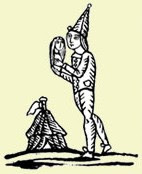
This picture of King Lear's Fool was drawn by Hannah Tompkins and I have used it for April, being the month of April Fools Day, and also to celebrate these essential characters in Shakespeares plays. You can see other images by this artist on the Shakespeare Art Museum website.
Read - three quarters of a book.
Completed - none
Currently reading - still Emma by Jane Austen
TBR Pile - 81 books (according to Good Reads) with one book added...
Birds Without Wings by Louis de Berniers
Challenges - still reading Emma as my Jane Austen choice, but have also been looking at potential Emile Zola titles too.
Wishlist Additions -
The Interpreter of Maladies by Jhumpa Lahiri
Grace by Alex Preby
The Prince of Mist by Carlos Ruiz Zafon
The Girl with Glass Feet by Ali Shaw
Of Bees and Mist by Erick Setiawan
Discoveries -
The Open University has 2 new under graduate arts courses...
AA100 The Arts Past and Present is the new arts foundation course at level 1
A150 Voices and Texts is a new introductory course in arts and humanities at level 1
Both of these sound very interesting.
Events - going to see Shakespeares A Comedy of Errors at the Royal Exchange Theatre in Manchester at the beginning of the month.
May is already underway, I have nearly finished Emma, and have lots of things to report on for next months roundup, including my trip to London this weekend just gone.

Sunday, 25 April 2010

The Iron Book of British Haiku


It has been a while since I have recommended a Haiku Anthology so I wanted to bring your attention to this brilliant collection which is published by the Iron Press. I have bought quite a few titles from them by mail order, although this one I got from a bookshop many years ago.
I have covered, in some of my other Haiku Anthology posts, both traditional Japanese humourous Haiku (Haiku Humour: Wit and Folly in Japanese Poems and Paintings) and contemporary American Haiku (The Haiku Year and The Unswept Path) so I thought I would give our wonderful British Haiku poets some air time.
My edition was published in 1998 and features British poets from then, and going back to the 1950's and 60's. The editors, David Cobb and Martin Lucas have been featured a number of times on my Haiku of the Week (see my sidebar), as have many of the other poets inside this book. Most of the prominent British Haiku poets are represented here, over 70, and it was the first major British haiku collection of its type
The format of the book is lovely, with the pages emulating the traditional parchment type of paper of the old Japanese form. The book has a simple aim, 'to present the best work of British haiku poets writing in English and Scots'.
An excellent addition to the library of any Haiku enthusiast, especially those who like the contemporary form. I have re-read this book many times, it has given me lots of pleasure over the years and I highly recommend it.

Sunday, 18 April 2010

Jane Austen Holiday


I was looking for a different type of holiday earlier this year, a literary holiday. I wanted to see what was on offer so I took a look on the internet. I have seen a few in the past, but abroad. When I looked in January the ones that I found were really expensive for just a few days, so I decided to do my own.
I spoke to some of my friends who are avid readers to see what their response would be, and they were very enthusiastic and thought it was a lovely idea.
I started looking into locations. There are a lot to choose from in the British Isles, some very obvious like Haworth for the Brontes (which we have already visited), and others less obvious if you use your imagination. I wanted an area we were less familiar with or we hadn't visited extensively before, with some nice countryside, and a literary connection, either to an author or a novel, or both.
After scouting for accomodation, and also other things to do (we don't want to be literaried out!) Hampshire, the home of Jane Austen won for our first Novel Holiday.
Going for a week, later in the year, we have agreed to read 2 books to discuss while away, one a Jane Austen naturally, and another contemporary novel, just to mix it up a bit. I already had a copy of Emma to read and nobody else had read it, so that was easily settled. Emma it was.
The second novel was more tricky, and it felt quite a responsibility to pick, not necessarily a likeable book, not too heavy or too easy, but interesting enough for people to want to read it and provide discussion material on our holiday. I settled on The Blue Fox by Sjon. I have heard quite a bit about it on the blogs, lots of interesting reviews and recommendations, and it seemed to offer something for everyone, plus it is not too long.
There are four of us, and we have a lovely wooden chalet in the New Forest itself. There are lots of Jane Austen locations to visit nearby, where she lived, the areas that influenced her, and Winchester cathedral where she is buried. There is also the forest, the coast and lots of other things to do. It is a while off yet but I am really looking forward to it.
If it goes well this year there may well be scope for doing other locations in the future. Anyway, I am about a third the way through Emma, and really enjoying it, so I had better get back to it.

Sunday, 11 April 2010

Ship Fever by Andrea Barrett


This book was one of my acquisitions from the book swap last year that I held in work. It is a collection of short stories that I thought, from the blurb on the back, were all different stories of people on a boat fleeing the potato famine in Ireland in the 1800's, but this only applied to the story of the title. The rest of the stories were on various subjects with science and scientific breakthrough's being the common thread.
The story of the title was the last one in the book, so you begin with the other very short stories first, some of which are only 10 pages long. Ship Fever itself is more substantial at 100 pages.
I read the first story and found it so dull I remember very little about it, other than it exploring 'the hybridization of the edible pea'. This phrase entertained me more than the actual story.
The second story was set in Uppsala in Sweden, a place I have actually visited, so it grabbed my attention initially, but this also faded and I could feel myself rushing the end to get it out of the way. At this point I considered giving up on the book entirely.
I then re read the blurb on the back, to try and reconnect with why I had picked it up in the first place, and most of the comments were about the title story, so I headed there instead and skipped the rest.
It starts with a letter written in 1847 from a Canadian in Ireland to his wife back home, about how dreadful the conditions are there during the famine. Her friend Lauchlin Grant reads her the letter. He is a doctor and has always loved her. Feeling inadequate against her husbands exploits, Lauchlin, in a fit of determined heroism, signs for a job at Grosse island, meeting the immigrants on the ships as they arrive from Ireland to administer necessary health measures before ushering the immigrants further upstream to Quebec and Montreal.
If only it was that simple. Lauchlin, and also us as readers, receive a severe wake up call, as the conditions on the ships and their wretched cargo of destitute people are described in horrific detail. The scale of misery goes beyond anyones imagination. It is in these descriptions that the text grabs hold of you and you are moved to plow onwards, to find out what the outcome is going to be for these characters. This story not only explores issues of survival, but also the value of family, and the problems faced by those who find themselves aliens in another country through no fault of their own.
This story saved the book for me and is evidently why it is the only story referred to in the blurb on the book. It is a highly moving account of a desperate episode in history and I cared for the people caught up in it. It almost seems as if the other stories in this book are from another writer. To me Ship Fever is the only story that I will remember from this book, and I am glad that I gave it a go. You can read an interview with Andrea Barrett about Ship Fever by clicking the link.

Sunday, 4 April 2010

March Roundup


How lovely are these dewdrops reflecting their surroundings. They were are from a list on a website called Environmental Graffiti, called Captured in Morning Dew (click the link for the other pics). This one is by Dylan Parker, click the link for his Flickr page. A beautiful picture for March.

Read - 2 and a half books
Completed -
The Zahir by Paulo Coelho
Atonement by Ian McEwan
Ship Fever by Andrea Barrett
Currently reading - Emma by Jane Austen
TBR Pile - 80 books (according to Good Reads) with 2 books added...
A Long Long Time Ago and Essentially True by Brigid Pasulka
The Blue Fox by Sjon
Challenges -
Completed Ship Fever by Andrea Barrett as my collection of Short Stories.
Currently reading Emma as my Jane Austen choice.
Wishlist Additions -
Brooklyn bu Colm Toibin
Arcadia Falls by Carol Goodman
The Year of the Hare by Arto Pasilinna
A Year in the Woods by Colin Elford
Discoveries -
Kneehigh Theatre - Totally Brilliant!
Events -
Bob Golding playing Eric Morcambe in Morcambe at the Liverpool Playhouse. Excellent!
Hansel and Gretal by Kneehigh Theatre (see above) at the Liverpool Everyman Theatre. Really inspiring, great fun and fantastic music. Loved it!
Organising a literary holiday for myself and some like minded friends. Details to follow in another post soon. Very exciting.
Hope you all enjoy a lovely Easter. Its lovely to see everything growing again, and to enjoy the spring and some plans coming together.

Sunday, 28 March 2010

My Cool Caravan by Jane-Field Lewis and Chris Haddon


Whenever someone buys me book vouchers as a present, I always try to buy something that feels like a special purchase that I will keep. So when I came across this wonderful book it was straight to the checkout with my vouchers and a smile, because anybody who knows me will know about my obsession with caravans.
I owned my own caravan, a static on a farm in North Wales, for 10 years, and she was my pride and joy. Sadly Big Bertha is only with us in spirit now, through photos and many happy, and almost legendary, times there, so I now indulge my obsession with pictures of other peoples caravans.
There was a time when caravanning and caravaners had taken a back seat to holidays abroad, and the modern caravanner was a dying breed, but I know many people of a certain age will harbour secret childhood memories of rainy family holidays staying in vans across the countryside. Like all icons of nostalgia, the caravan is enjoying a revival, for lots of different generations, and types of people.
This book ticked every box for me, lovely pictures of old retro type caravans, lovingly restored by their owners, with a piece for each one and their doting human companion. I wanted every one.
Every iconic type of van is represented, from The Teardrop and The American Airstream, to customised hybrids, trailers and other roadworthy dwellings. Some travel around, others are summer homes in the garden. All of them are highly loved and furnished with a befitting quirky style. Forty caravans are represented, of all vintages, and from across the world.
This is one of those books that not only gives me huge pleasure when I pick it up, but it also helps me realise there are many others who share my passion. There are others who understand.
I don't know if I will ever own another van. I think I have assumed that one day another will come my way, a Big Bertha II, or a Little Bertha. Who knows? Until then I have this book to keep me going.
There are many groovy caravan enthusiasts and societies about. If you feel inspired to see more caravan pics, check out this Static Caravan Appreciation Society set up on flickr.

Hay on Wye

Hay on Wye