This book was bought for me as a present for my birthday, along with another Cormac McCarthy novel. I was familiar with some of the films from this writers novels but this was the first that I had read for myself. I was in the mood for a book that took me to the wild prairies of America and the ranching life.
Book One in The Border Trilogy and set somewhere between the two World Wars (but surprisingly timeless), the story follows John Grady Cole, from Texas, a young and intuitive rancher with a deep love and understanding of horses. He and his friend, Lacey Rawlins set out for Mexico to find ranch work and the life that they love. On the way they pick up a young boy runaway, a decision that changes the course of their adventures and also their future. Encorporating a love story, friendship and stunningly beautiful scenery, this book was called 'One of the Greatest American Novels of this or any time' by The Guardian. So does it live up to this claim?
Coming from a less skillfully written novel before this one it was clear to me within only a few pages that Cormac McCarthy is by far a talent to be celebrated. The first page contained a 'sit up and take notice, in-take of breath' moment, and the writing was deliciously beautiful, in an indulgent, chocolate caramel way. The type of writing that causes involuntary sighs from the reader because of the satisfying beauty of the prose. Some of the passages in this book are some of the most beautifully written paragraphs or sentences that I have ever come across.
This is only four pages in...
'He rode back in the dark. The horse quickened its step.The last of the day's light fanned slowly on the plain behind him and withdrew again down the edges of the world in a cooling blue of shadow and dusk and chill and a few last chitterings of birds sequestered in the dark and wiry brush. He crossed the old trace again and he must turn the pony up onto the plain and homeward but the warriors would ride on in that darkness they'd become, rattling past with their stone-age tools of war in default of all substance and singing softly in blood and longing south across the plains to Mexico.' (p6)
McCarthy's use of repetition also served to validate the prose...
'When the wind was in the north you could hear them, the horses and the breath of horses and the horses' hooves that were shod in rawhide...'
or '...the women and children and women with children at their breasts all of them pledged in blood and redeemable in blood only.'
and I found it provided a rhythm that was comforting. I also liked the maturity of the voice telling the story, an assuring account of human nature that only comes with an experienced eye.
John Grady is the kind of hero we miss from old stories, steadfast, strong, reliable and entirely human. His sense of fairness compliments his passionate nature, for his own life, the woman he loves, his friend and the horses he surrounds himself with. You wouldn't go far wrong with this bloke on your side in an argument. These are men whose senses are heightened and do not spend much time on conversation.
The deceptively girlie title of the book hides the masculine content. This is an often brutal account of life on the land, with very few female characters, and a violent second half that had me holding my breath. Shocking circumstances left me wondering how on earth will they survive, only to lead to more shocking developments.
This is a gorgeous book on so many levels, the descriptions of the landscape and mans relationship with it, working with it and the horses. Also the accounts of friendship, and the determination to survive when others are determined that you will not. It was exciting and moving and a wonderful read.
Highly recommended for anyone wanting to visit a wild west that is about to be lost to machinery and corporate management very soon afterwards. Also for those who love quality writing that enhances sense of place and conveys tangible characters. I can't wait to get my hands on the 2nd novel of The Border Trilogy.
Reading Group Guides have discussion questions on All The Pretty Horses.
To go to Cormac McCarthy's website use the link.
Quote
The true university these days is a collection of books.
-Thomas Carlyle
-Thomas Carlyle
Showing posts with label American novel. Show all posts
Wednesday, 26 December 2012
Saturday, 10 March 2012
We Need To Talk About Kevin by Lionel Shriver

Dear Eva,
my friend lent me your book about 2 years ago and I have to admit I was unwilling to read such a dark story, especially when she herself had given up on it. I did however hang on to it with a view to reading it when I felt ready to, having heard great things about it.
It was the film that gave me the push (covered in the next post), and also a colleague at work reading it. It was finally time. I needn't have worried to be honest. I was sucked in from the start, and your story and your voice did not let me go until the last page.
Don't get me wrong, a lot of it was agony to read, horrific, a 'Thank God it is not me' kind of ride. A lot of your circumstances were not of your own doing. Did your son really turn out that way simply because you were not ready for a child? So many other mothers could say the same thing, but their children did not go on the rampage of murder.
I could feel your guilt, your despair seeping into the pages and through my fingertips. I heard your questions - 'Was it me?', 'Could I have caused this?' and, quite simply 'Why?' At least you tried to make an effort with a son who deliberately and systematically refused to co operate in any form. None at all.
Your husband, my goodness me, now there is a conundrum, chose to turn a blind eye. And what about his rejection, of your feelings, or any kind of understanding. What about his steady disregard, his slow annhilation of you and your personality, his lack of support, his obsession with his son representing the stereotype of American youth. He failed to comprehend who he was, a child who showed signs of cruelty in his rejection of others. I wanted to scream at him.
I did want to scream at you too.
Why did you put up with it all? You must have felt so alone, before and after. Your stoicism, your rigidity, your bloody mindedness, to take it all on yourself. Why stay in that town? You say it was for your son, who made it impossible to love him and then blamed you for not loving him. Your stubbornness let you down, like picking at a wound so it continues to hurt. Not many would have stayed, couldn't have. I know I would not have had the strength like you, blind strength of will and character. Only time will tell if your strength was your weakness.
I admire your honesty in all of this. I wish you well, you deserve some form of a small break, although I don't see one. I see the years of more of the same stretching before you, but not as clearly as you see it yourself. You have come this far which can be seen as a miracle, and you still haven't lost a sense of humour.
I thought this book was hailed because it tackled such a difficult subject, a woman whose son turns into a serial killer. This is only partly right. I am now sure it is hailed equally because it is written so brilliantly. Truly. I found your story moving and mesmerising, and I couldn't put it down.
Stop blaming yourself, the debt is not all yours to pay. I do not hope for your son, but I do hope for you.
Leah
Wednesday, 8 February 2012
Generation X by Douglas Coupland

This book was one of the titles I was challenged to read last year by AR who recommended it. I bought it then but have only just got around to reading it.
Three young people in their twenties in modern day America have moved away from the rat race to re-write their own lives by moving to the desert and forsaking the conformist lifestyle. Andy, Dag and Clare enjoy being with their dogs, taking picnics and telling stories.
Andy is the narrator, and he reviews how they all came to be there and their relationship with each other as well as the fantastic stories they tell each other. It is filled with humour as well as pop art pictures and even its own glossary of phrases invented to describe the emptiness of present society that produces cliched inhabitants. The book is short with chapters of only a few pages, so quick to read.
Often the writing is more social comment than fictional novel, and it took a while for me to warm to the characters. Their observations are interesting, funny, and scarily accurate, but this can come over as a bit clever and smug. We worked it out, have all the answers, and left the losers behind. But do they have all the answers? Are they living the perfect life?
As the novel moves forwards it seems that the threesome are still looking for something...more. Each of them have flurries back into the life they turned their back on. None of them stay but I got the feeling everything was transitory. No one reaches a point in life where they have nothing to learn, however much they feel they know it all. There are other characters, friends who visit for a while, but they serve as types to illustrate what the three have left behind.
There were some beautiful moments that I loved. The chapter where they all tell of what the earth means to them was a particular favourite. Remembering her most poignant moment from when she was twelve, Clare says...
'...my brother Allan yanked at my sleeve because the walk signal light was green. And when I turned my head to walk across, my face went bang, right into my first snowflake ever. It melted in my eye. I didn't even know what it was at first, but then I saw millions of flakes - all white and smelling like ozone, floating downward like the shed skin of angels. Even Allan stopped. Traffic was honking at us, but time stood still. And so, yes - if I take one memory of earth away with me, that moment will be the one. To this day I consider my right eye charmed.'
It was after this chapter, where the characters seem to move from merely frivolous and a little immature, that I found something to connect with. Later on, when Andy revisits his parents for Christmas, it was one of the saddest accounts of generational awakening that I have read.
Not everything in this book had an impact, but the chapters that did have stayed with me. Towards the end of the book the cleverness made way for quite a lot of sadness, and although upbeat, and even a little sentimental, the ending held no promises.
I would recommend this to anyone who loves modern writing that takes a cynical view of Western society. The closest authors I could think of were Chuck Palahniuk and Carl Hiaasen. This one has a more poetic slant, and is less ascerbic.
To look at Douglas Coupland's website use the link.
To read an interesting article Generation X to Generation Next by Laura Slattery use the link.
The Guardian Book Club has some good discussions about the book too.
Tuesday, 11 October 2011
The Age of Innocence by Edith Wharton

This was one of the titles I received on the Book Blogger Holiday Swap from last Christmas. Annabel Gaskel from Gaskella was my Secret Santa and the book was one of a number of goodies that made their way to my house. I started it while I was on holiday in Sweden and I have wanted to read it for some time.
Set in New York during the late 19th century, the novel follows the tightly knitted and highly constrictive society of the rich and privileged, governed by manners, etiquette and duty. This is a world where nothing is said outright, communication is subtle and with few surprises. Their lives are mapped out for them, and their biggest fear is any kind of discrepancy that would mean a blight on their families good name.
The narrator explains the intricate hierarchy of families while introducing us to the main players while attending the opera. Our main character, Newland Archer, handsome, successful and from a respected family, is soon to announce his engagement to May Welland, pretty, dutiful and from another good family, when the arrival of her cousin Ellen, throws a cat among the pigeons. The Countess Ellen Olenska, beautiful with bohemian leanings, was a childhood friend of Newland's, but has lived in Europe after marrying a Russian Count. Ellen's return, after the breakdown of her marriage, causes the New Yorkers tongues to wag, especially as her ways are not those of the families she had left behind. As her family try to support her, while limiting the damage her presence can do to them, Newland and May agree to bring their engagement forward in order to deflect public opinions of Ellen. Newland, however, has begun to question the constraints of duty and longs for a freer view away from duty. When he is asked, as a lawyer, to advise the Countess against seeking a divorce, an act that would do untold damage to her and taint her family, Newland finds himself becoming helplessly drawn to Ellen, and she to him.
I started this book not knowing how I would find it. I saw the movie with Daniel Day Lewis and Michelle Pfeiffer years ago, so I knew it was not an action packed affair, relying on the agonies of restraint, suppressed passion and the unsaid. A few people have said that they had to suffer its boredom on college literature courses, so I was very pleasantly surprised to find a lot of humour right at the beginning, while the narrator gives us a wry view of the great and the good. I found myself reading passages out to friends because I found it unexpectedly funny. The names are fantastic...Newland Archer, Lawrence Lefferts, Sillerton Jackson, and there seems to be a constant twinkle in the eye of the storyteller.
The sumptuous interiors of the houses and the expectations in behaviour are fascinating, and as alien as an anthropological study of an ancient tribe from a rainforest. Where this novel shone for me was the breathless intensity of forbidden feeling between Newland and Ellen, and the stifling lack of honest expression between Newland and May.
There were times where this compression of feeling was painful. On leaving Ellen after a brief meeting, where his feelings, as yet inexpressed and new, threaten to engulf him, this is a man who is surrounded by those who frown on feeling anything much,
'He bent and laid his lips on her hands, which were cold and lifeless. She drew them away, and he turned to the door, found his coat and hat under the faint gas-light of the hall, and plunged out into the winter night bursting with the belated eloquance of the inarticulate.'
The language is elegant and succinct, and I enjoyed reading this book very much because of it. I am guessing it was the suppression of feeling that made you, the reader, feel so much when it was alluded to. It is clear that Newland adores Ellen, it is shouting out of him, silently. His examination of his feelings for May are equally painful.
This is not a book for those who like pace and movement. It is populated by detail and stiff characters, dictated to by endless tradition. I can see why some, who are made to read it, view it with dread and boredom. I however really enjoyed it. Its lack of outer feeling made me feel so much. It reminded me of Jane Austen's witty and detailed examinations of the well off. I liked the historic setting, in a world changing so fast and desperately hanging on to their values for fear of any alternative.
Recommended for classics fans and those who enjoy historic society novels, and Jane Austen fans looking for something different.
For discussion questions on The Age of Innocence use the link.
Monday, 27 June 2011
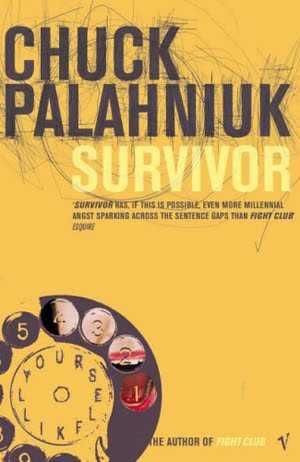
Survivor by Chuck Palahniuk
I was lent this novel by a friend. She didn't tell me much about it other than it was by the author who wrote Fight Club and I should read it. I got an inkling that she had not altogether enjoyed reading about the main character. I have not read anything else by the author but I loved the movie of Fight Club so I figured it was going to be an interesting one.Once again this year I was reading a book about a former member of an enclosed religious cult now let loose on the modern world (see Whit by Iain Banks) but it is there that any similarity between the books ends. What one tells you in great detail, the other uses language to hint at, allowing the reader to fill in the rest.
This is the story about Tender Branson, told by himself, as he hurtles deliberately to earth, alone on a jet soon to run out of fuel, recording his life on the Black Box recorder. A former home help hired out by his community, who have now committed mass suicide, he is one of the few hundred survivors of the cult, and the number is dwindling further due to cult member guilt and a murderer popping off the survivors. Soon our narrator is the only one left and becomes an evangelising celebrity sucked into the shallow world of fame and lies.
The book is intriguing from the start with the chapters and pages counting backwards. The narration is punchy, glib, and economical with words and information while we can fill in the gaps readily with our own observations on the image driven modern life of the West.
Tender Branson is not a loveable character, in fact I didn't care a whole lot about his fate at all. Seriously warped by his constrictive upbringing and then the banality of the outside world, he gets off on advertising his own phone number as a help line for the desperate so he can listen to their suicidal rantings. When, on his encouragement, one of them does himself in, he obsesses about finding his burial place. Enter Fertility Hollis, the victims sister, who can predict future disasters, and the plot goes off on several tangents at once, advancing our protagonist through many bizarre and extreme scenarios, before hurtling towards its conclusion.
This book is driven by comedy, not realism, and it takes everything that is bad about Western society, multiplies it by fifty, and gives us it back to laugh at and be appalled by it. We recognise this world but it has mutated to an alarming proportion. It is fast paced with multiple plot strands. Some of the strands end up ridiculously off-kilter.
This is not a book I would have read ordinarily so I enjoyed the refreshing angle, the unusual setup and the narrative which I thought was clever and suited the comment it was making. I did find that it lost pace in the second half though, and the ending just went nowhere so felt as if it ended abruptly with no surprises. Please be warned, if you are easily offended, have a staid sense of humour or have issues with suicide or extreme behaviour, this is not the book for you. However if you like Fight Club the movie you will certainly get the authors style, and if you want a satirical comment on how absurd aspects of our lives, especially driven by the media, have become, then this book will entertain. I will be careful who I recommend it to, but I have recommended it already.
A totally bonkers ride with scarily resonant messages, however extreme.
You can check out Survivor on Chuck Palahniuk's website by using the link.
There are quotes from Survivor, use the link, but remember, there will be spoilers.
Subscribe to:
Posts (Atom)
Hay on Wye